
Pages

Tuesday, September 2, 2014

Ritual Sacrifice and the Regla de Ifa

Havana and www-nomadxpedition.com


Artists borrow inspiration from life to express themselves. The worlds of arts and entertainment have often borrowed from Ifa –the religious traditions of the Yoruba, and its American cousin –Santeria. Most often found are sensationalized settings depicting images meant to inspire horror for dramatic effect. American film audiences are both thrilled and terrified by symbolism that seems frighteningly familiar and violently primitive.

It is no wonder that practitioners of these faiths meet with difficulty as they become more visible in American culture and society. Rarely depicted are core spiritual principles which include peaceful co-existence, the personal and spiritual goals of attaining balance in life, and of taking personal responsibility for one’s circumstances and actions. It is true that ritual sacrifices, ecstatic trances, spirit possessions, and ancient divinatory practices are all very alive within Ifa and Santeria. However, understanding the religion more deeply adds layers of symbolic meaning to which Hollywood images and depictions merely hint, but our instinctual minds respond.
02
Modern practitioners, those who come to Ifa and Santeria without previous heritage and familial ties, have many social taboos and indictments to overcome. Often, they find it difficult to study the sacred teachings or find spiritual mentorship. Even so, the number of initiates in this age of science and skepticism is on the rise.

By tradition Ifa and Santeria have been historically secretive in sharing their ways and practices. This is born out of a need to protect initiates from persecution by other religions –most notably Christianity. The majority of practitioners come from “word of mouth” Oral traditions, where teachings are passed down within a family or casa de santos (house of saints), also known as an ilé. Those coming from outside cultures seeking to learn the ways and practices of Ifa and Santeria often meet with mistrust and hostility, as they seek out information and attempt to interact with seasoned initiates.

Neophytes most often run into trouble when their understanding of the practices come with little or no practical example, or trust worthy guidance. Those coming from outside the tradition often lack the cultural background and experiences which would otherwise assist them in deriving deeper meaning and reverence for the ways and practices. This lack of understanding does create fissures between new initiates and those who have grown up in the faith. However, it is no surprise that cultures dominated by Christianity find the religious practices of Ifa and Santeria difficult to understand let alone accept. Christianity left behind ritual blood sacrifices, with all the cultural and symbolic implications, when it embraced the idea of a “final sacrificial savior,” and created the symbolic enactment of the Eucharist. The ensuing passage of time has alienated many Christians from their ritual past and from other cultures and faiths that retain blood rites and practices. The deeper symbolism and meanings associated with ritual animal sacrifice are easy to dismiss, or reject as horrendous, when there is no personal context associated with shedding blood. The entertainment world takes advantage of these cultural rifts when choosing images, and depicting distorted, or even honest scenes of ritualized animal sacrifice, ecstatic frenzies, spirit possession, and other practices.

10
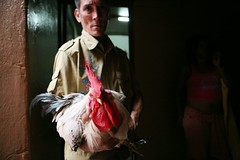
Industrialization of the food industry has further estranged modern societies from the bloody business of slaughter. Gone are the days when killing and plucking a rooster for Sunday dinner was an American family norm. Modern American's, especially those removed from rural life, are often repulsed and confused when slaughter occurs as part of religious practices. People from cultures where industrialized farming and Agribusiness are the way of life, often have difficulty conceiving of or witnessing any form of slaughter. In cultures where the slaughter and butcher of meats in the home remains prevalent, people have very little difficulty accepting ritual sacrifices as part of religion. "We feed ourselves and we feed the Gods." For these people ritual sacrifice is often part of everyday life. These are the kinds of cultures where Ifa, and Santeria are well established and visible.

Whether the entertainment industry has benefited these religions through increased exposure, or harmed them through negative depiction, is a matter of debate. What is certainly true. . . the worlds of arts and entertainment will continue to derive inspiration from them, religious scholars will investigate and share their findings, and dedicated initiates will continue to practice.

For information on the ritual practices of Santeria, refer to Sacrificial Ceremonies of Santería: A Complete Guide to the Rituals and Practices
, authored by Ócha'ni Lele , published by Destiny Books.

  Come back and read our review Friday, 9/5/2014.

Friday, August 29, 2014

Protected is "Breath Catching!"

Book Title:  Protected
Author: Rowena Portch
ISBN: 1432758667
Publisher: Outskirts Press Inc.

Fantasy and romance fiction lovers alike are in for a delightful and surprising read as author Rowena Portch presents Protected, book one of the Spirian Series. Portch successfully gifts the reader with a heroine and a story that will capture as well as excite the imagination, deeply satisfying the avid reader's hunger for freshness with a style and plot line all her own.

Skye is a blind massage therapist with special gifts and a bright spirit that has attracted the wrong attention. Skye's power to heal has been noticed, making her the coveted target of those who would steal her freedom and manipulate her gifts. The fate of her race rests on choices she must make. Poised in the balance point of shifting powers, Skye must choose her loyalties well. One wrong choice will tip the balance between redemption and destruction. If she falters, she dooms not only her race but all of humanity. Vulnerable in ways that would terrify and immobilize lesser spirits, Skye transcends the circumstances of her blindness to wage a battle for Spirit and for all of us.

Portch has drawn from her own life and history to write Skye's character and world, sharing in a way that only a skilled and talented writer can -- the very personal experience of blindness. Not only has Portch succeeded to write a blind character in a sighted world, she has done so in such a way as to create a world paradigm, characters, and circumstances that elevate this book from the ranks of a good story to that of a great read.

The Protected is full of rich descriptions, breath catching tension, humor, and desire, with characters that come to life and walk off the page to live in you. With a voice and experience uniquely her own, author Rowena Portch will make you believe the world she writes and you will seek it inside yourself.


Monday, August 25, 2014

Spirian Series Author Brings New Dimension to “Blind Seer” Heroine.

Ink Slinger's Whimsey would like to share with readers information about an eye condition called retinitis pigmentosa and introduce a fiction author, Rowena Portch, writer of The Spirian Series, who has overcome the condition in her own life; using it to enhance her work. Protected, book one of the Spirian series, will be our featured book review later this week.

Retinitis pigmentosa is a group of degenerative eye diseases affecting one in 4,000 people in the United States and roughly one out of 5,000 people Worldwide. The retina, which is located at the back of the eye, sends visual images to the brain. In patients with this disease, damage to the retina gets worse over time. Retinitis pigmentosa (RP) commonly runs in families and can be caused by a number of genetic defects. For those with RP, the photo receptors in the eyes progressively degenerate, causing side or peripheral vision, to slowly worsen over time. Night vision is also diminished, with central vision typically declining in the advanced stages of the disease. The condition may eventually lead to blindness, with most patients retaining at least partial vision, total vision loss being rare. Wearing sunglasses will help protect the retina from ultraviolet light and may help preserve vision, and vitamin A may slow the disease from getting worse but there is currently no known cure or effective treatment for RP. Signs of RP can usually be detected during a routine eye exam however; symptoms usually do not develop until adolescence, around 10 years old. Severe vision problems do not usually develop until early adulthood.

Author Rowena Portch retired from her successful career as an editor at Microsoft, when she lost her vision to RP. After leaving Microsoft, she and husband Gregg opened the Abel Wellness Center on Washington State’s Olympic Peninsula. Portch had already been writing professionally for over 30 years when she set out to write her ambitious 5 part Spirian Series. The Protected, book one of the series was released on May 11, 2010, rapidly growing a fan following and favorable reviews.

The Protected, are a supernaturally gifted race of beings, not quite human but not fully spirit, that secretly share this planet. Among themselves they are known as Spirians, a race caught between the physical and spiritual realms – where anything is possible. Skye, a blind massage therapist, has lived her whole life as human and is unaware of her race and the path her life is about to take. Skye may be the prophesied “Healer” whose gifts are pivotal in the course of her people’s future; a future that could bring about the enslavement of humanity. The Protected, book one of the series, takes the reader with Skye into the hidden world of the Spirians, where a few stand in the balance ready to teach Skye to use the power that is her birthright before she becomes a pawn in a much larger game.
“The depth of realism and texture Portch has written into the character and world of her “Blind Seer” heroine is untouchable by the writings of sighted authors. Once you read The Protected you’ll never believe another author trying to write blind again. Portch has written a unique and engaging series that will thrill and inspire
readers.” - Reviewer Vonnie Faroqui, of Ink Slinger's Whimsey
Learn more about Rowena Portch and the Spirian Series from her website at http://rowenaportch.com/ or by following her on http://twitter.com/RowenaPortch and at http://bit.ly/Facebook-RowenaPortch.


Friday, August 22, 2014

Inspired! Teachings of the Santeria Gods: The Spirit of the Odu


Book Title: Teachings of the Santería Gods: The Spirit of the Odu
Author: Ocha' Ni Lele
ISBN: 1594773327
Publisher: Inner Traditions
Reviewer: Vonnie Faroqui

Ocha'ni Lele's Teachings of the Santeria Gods is an essential addition to the spiritual library of anyone who is pursuing a study of or with interests in the practices of orisha worship and Santeria. With this work the author begins what will be a life-long pursuit to preserve and pass on the living and sacred stories or patakis of the Santeria and Lukemi. The volume includes more than 100 stories and histories about the odu and the orishas; breathing life into what was becoming a disappearing oral tradition.

With great skill and care Ocha'ni Lele, begins by giving an insightful introduction to the dilloggun, the sacred system of divination practiced by the Santeria. He goes on to share the patakis, whose themes are as relevant today as they were in the past, more so in the modern age of technology as people move farther away from authentic spiritual communion. For each odu or pattern in the diloggun, the author has written a chapter explaining the major theme or teaching of the odu and shares several illustrative patakis. In this way the knowledge revealed is more easily understood, remembered and applied. Ocha'ni Lele's writing is both timeless and inspiring. The formatting of the book makes for easy reading. The presentation of each story's thread is deeply satisfying as well, providing food for a growing understanding in the wisdom teachings and the diloggun.

I found more insight and information regarding the practices and teachings of the Santeria through this one book than I have found in all the previous years of searching, and I am deeply gratified to the author for his work. I especially enjoyed the stories of Okana, whose journey through the tales serves as a powerful lesson for many practitioners and energy workers of both the right and left paths. `Obatala Eats Heads' and the patakis for odu Osa are among my favorites.

Himself a Priest of the religion and child of Oya, Ocha'ni Lele opens the door of understanding and leads the reader in to the mysteries, delivering the telling of the tales with a love and enjoyment that shines through. A skilled writer with personal experience and passion for the work, Ocha'ni Lele's treatment of the stories is not simply academic, but flows from the heart and in so doing reveals more than scholarly acumen.

Those who have a deeper interest and motivation to discover the stories and the truths held within will be especially gratified as Ocha'ni Lele imbues new life and vigor into the telling of these traditional patakis. This inspired work has become a treasured volume in my personal collection.


Tweet

Saturday, August 16, 2014

Savoring "Night Crossing" . . . a Review

When I planned the schedule of blogs with my intention to post this review Friday, August 15, I had not considered that Night Crossing is a book with its own spirit and purpose. There are questions being asked that will arrest progress through its chapters by capturing thought and time. And so, I come late to write my review.

When you drink wine, do you gulp it down; racing to the bottom of your glass? Do you savor it; holding it in your mouth; flicking it with your tongue; allowing yourself the pleasures of experiencing its texture, the changing flavors as it rolls over your taste buds, splashing against your palate. Night Crossing is a story that, like pleasing wine, deserves to be savored.

 
Title: Night Crossing
Author: Mary E. Martin
Series: The Trilogy of Remembrance
Publisher: iUniverse (June 20, 2014)
ISBN-10: 1491737158
ISBN-13: 978-1491737156

The Trilogy of Remembrance comes to an inspired and satisfying conclusion in, Night Crossing. Enter our hero and favorite artist, Alexander Wainwright, vision guided into a swirling dream like progression of thought, darkness, light, and dancing rhythms which open windows to the heart and soul of creative experience. He is the student and the observer of life. He journeys, inspired and driven by compulsions and forces he does not understand, meeting guides and antagonists along the way. Each in turn adds to the mysterious patterns being woven around him. Their destinies entwined.  His muse Daphne, faithful narrator Jamie, and friends both new and old will enter your heart and find their way to places that resonate. A new story unfolds, new mysteries are explored as Alex frees his unique inner light and searches for the place love holds in his art. These characters breathe. They hurt and love, like we hurt and love. Their stories, choices, and struggles give us pause because they are stories we recognize as versions of our own.

I love Mary’s writing, which is eloquent and full of human insight. In Night Crossing, as in the previous books of the trilogy, she reveals surprising depths of interest and perception –both spiritual and aesthetic, into the visual, musical and performance arts.  Through her story telling she has the reader pondering many ideas, concepts and truths relating to creativity, spirituality, and life. Her writing illuminates much and yet leaves room for further exploration. I find her work entrancing and provocative, without being pushy. I will miss Alexander and find myself wondering how she might work him into another novel or series now that his trilogy is complete.

Do I recommend Night Crossing? Oh yes, yes indeed, I do.

Synopsis: Magical light suffuses Alexander Wainwright's paintings. But he must find something new. A vision of a golden sphere studded with gems appears before him-the cosmic egg, source of all creativity. Next day, his art dealer shows him an unsigned painting of the very same cosmic egg dedicated to a Parisian pianist, Dumont. Does the cosmic egg exist not just in Alex's imagination but in the real world? That burning question drives Alex to take the ferry-a night crossing- from Portsmouth to Caen and then onto Paris to find the pianist and the artist. On that trip, the elderly Miss Trump, enters Alex's life with myriad mysterious effects. The ferry capsizes. Alex tries to save her and a young mother and her child. Miss Trump drowns but mother and child are safe. When her body is mistakenly cremated, Alex is seized with an inexplicable sense of responsibility and carries the ashes with him to Paris where he simply comes across Dumont playing in a café. The pianist says the painter, Anton, is in St. Petersburg. Still determined to carry the ashes, Alex travels by train to St. Petersburg to find the artist. Stunning revelations await him. Learning far more than imagined, he finally understands the meaning of his vision and the true purpose of carrying the ashes across Europe. But when he returns to London, he may find that he has lost what he cherishes most-Daphne, his love and muse. This tale is about love so strong it transcends life and death. It's about cruelty and compassion, life, art and the magic of creation. All told, it speaks of that yearning within us for what lies beyond.

Mary E. Martin is the author of two trilogies The Osgoode Trilogy set in the corridors of power in the world of the law, and The Trilogy of Remembrance set midst the glitter and shadows of the art world.


Monday, August 11, 2014

Trilogy of Remembrance: an interview with author Mary E. Martin

In celebration of publishing part three in her Trilogy of Remembrance --Night Crossing, I am posting an excerpt from an interview I did with author Mary E. Martin, when book two, The Fate of Pryde, was released.

Read our review of Night Crossing when it posts on Friday, August 15, 2014.

It is always a pleasure to speak with an author about their work and process, but Mary's interview was especially interesting. She gave our readers a fair amount of personal insight into what motivates her as an author, as well as her writing process for the Trilogy of Remembrance.  Today's excerpts will only include questions and answers pertaining to the Trilogy of Remembrance.

Mary E. Martin  is the author of two trilogies The Osgoode Trilogy set in the corridors of power in the world of the law, and The Trilogy of Remembrance set midst the glitter and shadows of the art world.

This excerpt has been taken from the Ink Slinger's Whimsey blog for,  August 24, 2011.

Author Mary Martin
Martin: My second trilogy of novels [The Trilogy of Remembrance] is about an artist, Alexander Wainwright, Britain’s finest landscape painter. The genesis of this trilogy occurred many years ago, before the publication in 2005 of my first novel, Conduct in Question, the first in The Osgoode Trilogy.
A writer friend/mentor of mine challenged me to write something other than a mystery novel. And so, I tried to write a romance, with little success. I had a man and woman meet while travelling on [believe it or not] the Orient Express to Venice. After thirty pages, I was getting bored. I knew enough to say that if the writer is bored, heaven help the reader!
At that moment in time, I envisioned a mysterious character who pretty much appeared in the room in my imagination. At once, I knew he was the protagonist for the book. It took a long time to get to know him, but after innumerable character sketches and other jottings, he became Alexander Wainwright, Britain's finest landscape artist. He would be the main character around which the next trilogy would be built. So, I suppose it was Alexander, himself, who inspired the trilogy. Once I got to know him a little bit, I found he had a great deal to say.
My experience has been that the characters an author creates are a part or aspect of oneself. Consequently, the growth of Alexander — a person who believes that there is much more to this world than meets the eye — probably is my inquiring, prodding, reflective self. I present him with many questions to which I personally want to find answers.

The next novel in this trilogy—The Fate of Pryde—will published this fall on Amazon’s CreateSpace. Again, Alexander is the protagonist and I’ve presented him with a new character from whom he has much to learn, Jonathan Pryde. Pryde is an extremely wealthy patron of the arts who wants to commission Alex to create a vision in stained glass for his residence in Vence in the south of France. Alexander hesitates. After all he is a painter, not a glass cutter. But Alex is drawn into Jonathan’s strange and murky world. At the foot of the garden of Pryde’s chateau-like home, stands a bunker protecting his secrets. In this novel, the question posed to Alex is—How can the very best and the very worst of humankind reside in one’s man breast?
And so, I love to present my protagonist with all sorts of problems to reflect upon. I have a few ideas for the next novel, but the trick, as always is to create a driving plot to find all the questions and— a few answers.

Faroqui: How do your books evolve? Do you get a creative burst which eventually matures into a novel? Do you pick a theme and lay a foundation? How do you approach the creative process?

Martin: I think each novel evolves in its own way. A lot like raising children—each one is quite different. It seems I do a lot of work “in the back of my mind” and so, when it’s ready, I sit down and get started. The growth of The Drawing Lesson was quite unusual. In fact it started out as a novella or even three novels and so the structure of a full novel was not really in place at the outset. Parts or scenes of the novel kept “floating up” to me and I would write them down without really knowing why. And so, I made a rule for myself—not to throw anything out until much later. It was like walking on a beach and coming across different shells and having to decide whether to pick one up and carry it home or not. Not until the end of the process did I cut out or change significant portions of the manuscript.
So, sometimes it starts out as an idea or a kind of character or a bunch of questions. I think I’m a pretty “organic” writer in the sense that I like the natural flow of the story to take over and guide me where it wants. I’m a great student of Carl Jung and consequently really believe in the power of the subconscious, which I think is a lot smarter and more creative than I am.

Faroqui: Some people believe that in order to be truly creative a person has to be tormented, or have deep inner turmoil? What do you think of that notion?

Martin: No! At least I certainly hope not. Much is made of battles with inner demons. But it’s interesting you should ask. In fact, Alexander Wainwright does have a battle like that in The Drawing Lesson. Suddenly, this artist, known for his beautiful landscapes bathed in an ethereal light, starts painting trolls—ugly humanoid creatures—along the riverbank of his most recent painting. Of course this heralds a breaking up of his art so that he can advance creatively. I guess I’ve inflicted that on Alex so that I don’t personally have to deal with it. But seriously, I don’t think you have to suffer in order to create. I guess you do go down into the subconscious where wonderfully creative stuff resides, but so does a lot of stuff of nightmares.

Faroqui: What do you hope readers will come away with when they read one of your books? Do you send messages through your work, hoping to inspire perhaps?

Martin: I hope the reader will enjoy looking beneath the surface of life for various layers of meaning and have found moments of quiet reflection. But, I also hope the reader has also been fabulously entertained with a great story and fascinating characters. In the weeks and months to come, he or she will think back to something in The Drawing Lesson or The Fate of Pryde and say— "This person I've just met in real life reminds me of a character in that novel like Rinaldo or Daphne or Jonathan Pryde."

Link to the full interview, 8/24/2011.

Friday, August 8, 2014

Comforting Accounts of Communication from the Afterlife

Book Title: He Blew Her a Kiss: Communications from loved ones who have passed
Authored by: Angie Pechak Printup and Kelley Stewart Dollar
ISBN: 1432760920
Publisher: Outskirts Press

He Blew Her a Kiss is a collection of inspirational stories relating experiences of communication from loved ones who have passed. The entire volume has been compiled, with sincere and gentle treatment by the authors, from email submissions by and personal conversations with ordinary people.

Accounts of after death communication [ADC] are difficult to explain in terms of religion or dogma, but are not uncommon, regardless of cultural or ethnic background. However, acceptance of the phenomenon is not necessary for enjoyment of the book. Instead of being sad or depressing the stories are touching and within moments will draw the reader into empathic resonance. The book will be especially gratifying to those who have had similar mystical experiences. Readers who have second hand or no ADC experiences to share, but for who near death and after death experiences are of interest, will also be attracted to these life affirming stories.

The idea for the book came to Angie Printup after a dear friend related what might be called, an extraordinary coincident by some and by others, a tiny miracle of after death communication. Kelley Dollar, a long time friend of Printup, was asked to assist in transforming the rough first person stories into a third person narrative form that proves to be both thoughtful and effective. The authors show tremendous sensitivity and embrace the mystery of ADC experiences with loving acceptance. It is obvious from the care and treatment of the stories that helping others overcome devastating loss and grief is the primary purpose of this work and their book. They have been tremendously successful in compiling the stories tastefully, without unnecessarily adding to or sensationalizing the individual accounts.

Believing that our consciousness continues after death, or in the possibility of communication with loved ones who are in spirit, is unimportant next to the immeasurable comfort and relief sharing these experiences bring. It is hard to refute the validity of a mystical experience one has not shared and the authors waste no time in trying to win supporters. They simply and deftly offer the stories up as messages of hope and comfort. Those with similar accounts to share will immediately relate and waste no time in debating the validity of ADC. Others will look to these stories for inspiration and as an affirmation of faith guiding the way into an afterlife full of hope and continued purpose.

He Blew Her a Kiss is a beautiful volume of collected stories that you will want to share with others. Not all of the stories are dramatic examples of after death communication, relating instead simple and poignant moments which have brought healing in times of grief. Some of the accounts are quite extraordinary and impossible to explain; all are uplifting and demonstrate humanity's capacity to love beyond any obstacle, even death. The book is slim, attractive and would make a wonderful gift for conversational reading and is suitable for those suffering loss as an aid through times of grief.

Thursday, July 31, 2014

A God Who Believes in You . . .


" Most people believe in God, they just don't believe in a God who believes in them."
Communion. . . is fifth in the Conversations With God series of inspirational books, written by author Neale Donald Walsch.  Books from the series have graced the New York Times best selling list and continue to receive attention, both positive and negative, from fans and critics respectively.

Don't make the mistake of brushing aside this book based on critical reviews from sources like Publishers Weekly. Their sales and political agenda aren't served by expressing an honest appreciation or experience of this material. Especially as their continued success is built on maintaining the world paradigm that currently exists.  Their opinions need to be jaded enough to satisfy religious followers that Publishers Weekly, and others like them, don't personally subscribe to the kinds of heretical views and alternative thinking a book like Communion With God invites. These conversations between Neale and God are deeply compelling, and Communion stands proudly with its fellows as being a soul shaping, thought bending and inspirational read.

Communion with God is less conversational than the previous five books, taking a first person narrative approach, as though from the voice of God. Some objection has been made by other reviewers over the change in tone this approach creates, but I found the effect compellingly meaningful. This conversation became more personally empowering for me than the other books were.  I left it feeling as though I had the ability to change my life experience.

In Communion, the God voice is very forthright in addressing "ten illusions of humans" and how each of these illusions has shaped history, leading us further and further away from an authentic relationship with God, and or rather, Life.  If you are threatened by the New Thought movement, or by exploring alternate ideas about the nature of God, humanity and even reality -as presented by the religious and even political powers that be, this is not going to be comfortable reading. However, if you take enjoyment in exploring new perspectives and paths of understanding, this book is going to thrill your spiritual socks right off! It might even make you a believer.

The ten illusions of humans, as examined in this conversation, are likely to challenge and change the readers understanding of reality in a very liberating and inspirational way. There isn't much in life that holds more reward than discovering a broader perspective and readers are going to find rejecting the insights offered into human spirituality and the nature of reality difficult. Well, that is unless the reader's ego, religious, or financial investment is in maintaining the status quo.

I highly recommend reading Communion With God, as the experience will be a life changing opportunity for any and all readers.  People with or without faith and religious beliefs will be moved and challenged by the insights offered. Even if you are a die hard religious fundamentalist, there is merit to be found in examining the illusions of humans and the world created out of them as presented in Communion With God.

Communion With God gets both thumbs up, and a blue ribbon of excellence from this reader.


We Are Back!

We are back and getting ready to post some amazing reviews! Look for Reviews of Mary Martin's latest book, Night Crossing, and great reviews for other cherished authors old and new over the next few weeks. Our return is coming on a high note!

Monday, January 9, 2012

Class Act, Selling More Books Through School and Library Author Appearances

Join me in this video interview with author Barbara Techel as she shares her book, Class Act: Selling More Books Through School and Library Author Appearances.

We had a great time using Skype to create this video interview for a Writers In The Sky Podcast. The video format allowed us to add visual elements, slides and URL information, to create a dynamic and engaging experience. Video is a new direction for my interviews and I hope that you will both benefit and enjoy what I have put together.

Barbara Techel is a wonderful author, with an engaging interview personality. She is every blog host's dream, offering clear information and advice with ease and experience. Her book, Class Act, is chuck full of valuable tips for making author appearances profitable and effective as a marketing strategy.

I highly recommend Barbara's book to every author as an excellent marketing how to. Barbara shares information on how to pitch a presentation to schools and libraries. Class Act includes her tips on, how to determine what to charge for an appearance, covering elements of presentation and technology use that are invaluable.