Pages

Showing posts with label Santeria. Show all posts

Friday, September 5, 2014

Sacrificial Ceremonies of Santeria - A Review

Skilled as an orator, writer and priest, Ócha'ni Lele brings a deep love and understanding for Santeria to his readers. The excellent writing and composition style of Sacrificial Ceremonies of Santería: A Complete Guide to the Rituals and Practices
lends itself to an ease of understanding and imparts a depth of knowledge that is invaluable to those who are seeking growth in the religion. The sacred stories come alive, while annotations broaden without becoming dry and academic in tone. With so many seekers and so few available teachers, Sacrificial Ceremonies of Santeria is by far the most in-depth and skilled presentation of the sacred rituals and practices available. Anyone interested in the religious history and traditions purely from an academic standpoint will be pleased at the level of attention given to cross referencing information with the diloggun, patakis, and other scholastic records.

As the daughter of a fundamentalist minister, I was vastly intrigued and greatly impressed by the incredible dedication author Ocha'ni Lele gave in presenting the sacred rituals in Sacrificial Ceremonies of Santeria. I found this book to be deeply enriching. As one who was raised in a religion which no longer participates in ritual blood sacrifices, outside of symbolic practices, I found it enlightening to be presented with a living example of ancient sacrificial rites. In learning about the sacred rituals and practices of Santeria, I found a new level of understanding for the value and significance of blood ritual. I think this book would serve serious students of Christianity well in understanding the impact ritual sacrifice and the cessation of such practices has had on the development of their own religion and culture. I am sure each reader will be impacted differently, based on their personal level of understanding and spiritual inclinations; however, there is great room for growth and healthy discussion to be enjoyed through broadening one's perspective.

Alive with rich imagery, sacred storytelling, and detailed analysis, there is no better transmittal or loving record of this vital information available to friends and family of the Orishas, than that which is being transmitted through their vessel, Ócha'ni Lele, in Sacrificial Ceremonies of Santeria: A Complete Guide to the Rituals and Practices.

Author: Ócha'ni Lele
Publisher: Destiny Books (August 22, 2012)
ISBN-10: 1594774552
ISBN-13: 978-1594774553
Rating: 5 Star

Tuesday, September 2, 2014

Ritual Sacrifice and the Regla de Ifa

Havana and www-nomadxpedition.com


Artists borrow inspiration from life to express themselves. The worlds of arts and entertainment have often borrowed from Ifa –the religious traditions of the Yoruba, and its American cousin –Santeria. Most often found are sensationalized settings depicting images meant to inspire horror for dramatic effect. American film audiences are both thrilled and terrified by symbolism that seems frighteningly familiar and violently primitive.

It is no wonder that practitioners of these faiths meet with difficulty as they become more visible in American culture and society. Rarely depicted are core spiritual principles which include peaceful co-existence, the personal and spiritual goals of attaining balance in life, and of taking personal responsibility for one’s circumstances and actions. It is true that ritual sacrifices, ecstatic trances, spirit possessions, and ancient divinatory practices are all very alive within Ifa and Santeria. However, understanding the religion more deeply adds layers of symbolic meaning to which Hollywood images and depictions merely hint, but our instinctual minds respond.
02
Modern practitioners, those who come to Ifa and Santeria without previous heritage and familial ties, have many social taboos and indictments to overcome. Often, they find it difficult to study the sacred teachings or find spiritual mentorship. Even so, the number of initiates in this age of science and skepticism is on the rise.

By tradition Ifa and Santeria have been historically secretive in sharing their ways and practices. This is born out of a need to protect initiates from persecution by other religions –most notably Christianity. The majority of practitioners come from “word of mouth” Oral traditions, where teachings are passed down within a family or casa de santos (house of saints), also known as an ilé. Those coming from outside cultures seeking to learn the ways and practices of Ifa and Santeria often meet with mistrust and hostility, as they seek out information and attempt to interact with seasoned initiates.

Neophytes most often run into trouble when their understanding of the practices come with little or no practical example, or trust worthy guidance. Those coming from outside the tradition often lack the cultural background and experiences which would otherwise assist them in deriving deeper meaning and reverence for the ways and practices. This lack of understanding does create fissures between new initiates and those who have grown up in the faith. However, it is no surprise that cultures dominated by Christianity find the religious practices of Ifa and Santeria difficult to understand let alone accept. Christianity left behind ritual blood sacrifices, with all the cultural and symbolic implications, when it embraced the idea of a “final sacrificial savior,” and created the symbolic enactment of the Eucharist. The ensuing passage of time has alienated many Christians from their ritual past and from other cultures and faiths that retain blood rites and practices. The deeper symbolism and meanings associated with ritual animal sacrifice are easy to dismiss, or reject as horrendous, when there is no personal context associated with shedding blood. The entertainment world takes advantage of these cultural rifts when choosing images, and depicting distorted, or even honest scenes of ritualized animal sacrifice, ecstatic frenzies, spirit possession, and other practices.

10
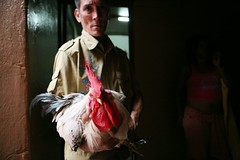
Industrialization of the food industry has further estranged modern societies from the bloody business of slaughter. Gone are the days when killing and plucking a rooster for Sunday dinner was an American family norm. Modern American's, especially those removed from rural life, are often repulsed and confused when slaughter occurs as part of religious practices. People from cultures where industrialized farming and Agribusiness are the way of life, often have difficulty conceiving of or witnessing any form of slaughter. In cultures where the slaughter and butcher of meats in the home remains prevalent, people have very little difficulty accepting ritual sacrifices as part of religion. "We feed ourselves and we feed the Gods." For these people ritual sacrifice is often part of everyday life. These are the kinds of cultures where Ifa, and Santeria are well established and visible.

Whether the entertainment industry has benefited these religions through increased exposure, or harmed them through negative depiction, is a matter of debate. What is certainly true. . . the worlds of arts and entertainment will continue to derive inspiration from them, religious scholars will investigate and share their findings, and dedicated initiates will continue to practice.

For information on the ritual practices of Santeria, refer to Sacrificial Ceremonies of Santería: A Complete Guide to the Rituals and Practices
, authored by Ócha'ni Lele , published by Destiny Books.

  Come back and read our review Friday, 9/5/2014.

Friday, August 22, 2014

Inspired! Teachings of the Santeria Gods: The Spirit of the Odu


Book Title: Teachings of the Santería Gods: The Spirit of the Odu
Author: Ocha' Ni Lele
ISBN: 1594773327
Publisher: Inner Traditions
Reviewer: Vonnie Faroqui

Ocha'ni Lele's Teachings of the Santeria Gods is an essential addition to the spiritual library of anyone who is pursuing a study of or with interests in the practices of orisha worship and Santeria. With this work the author begins what will be a life-long pursuit to preserve and pass on the living and sacred stories or patakis of the Santeria and Lukemi. The volume includes more than 100 stories and histories about the odu and the orishas; breathing life into what was becoming a disappearing oral tradition.

With great skill and care Ocha'ni Lele, begins by giving an insightful introduction to the dilloggun, the sacred system of divination practiced by the Santeria. He goes on to share the patakis, whose themes are as relevant today as they were in the past, more so in the modern age of technology as people move farther away from authentic spiritual communion. For each odu or pattern in the diloggun, the author has written a chapter explaining the major theme or teaching of the odu and shares several illustrative patakis. In this way the knowledge revealed is more easily understood, remembered and applied. Ocha'ni Lele's writing is both timeless and inspiring. The formatting of the book makes for easy reading. The presentation of each story's thread is deeply satisfying as well, providing food for a growing understanding in the wisdom teachings and the diloggun.

I found more insight and information regarding the practices and teachings of the Santeria through this one book than I have found in all the previous years of searching, and I am deeply gratified to the author for his work. I especially enjoyed the stories of Okana, whose journey through the tales serves as a powerful lesson for many practitioners and energy workers of both the right and left paths. `Obatala Eats Heads' and the patakis for odu Osa are among my favorites.

Himself a Priest of the religion and child of Oya, Ocha'ni Lele opens the door of understanding and leads the reader in to the mysteries, delivering the telling of the tales with a love and enjoyment that shines through. A skilled writer with personal experience and passion for the work, Ocha'ni Lele's treatment of the stories is not simply academic, but flows from the heart and in so doing reveals more than scholarly acumen.

Those who have a deeper interest and motivation to discover the stories and the truths held within will be especially gratified as Ocha'ni Lele imbues new life and vigor into the telling of these traditional patakis. This inspired work has become a treasured volume in my personal collection.


Tweet