Pages

Showing posts with label Article Marketing. Show all posts

Thursday, November 20, 2014

How Google's Panda Makes Content "King" for SEO.

"Content is King" for Google's Panda
Bow down because Content is King for search engine optimization.
Google's newest page ranking algorithm, Panda, is smarter than ever, able to recognize and make relevant content distinctions.  This has had a deep impact in online marketing circles and spammy strategies aren't going to yield results.

Google Releases the Panda

In February of 2011, internet marketers everywhere were shocked. Google had released a new update, and with it, changed the way SEO would work forever.

At first, it was difficult to know exactly what the damage was. Massive "authority" websites were reporting HUGE losses in traffic. But it wasn't mindless destruction - no, Google's latest update targeted a specific group of websites with surgical precision.

These were websites who played a crucial role in SEO. Websites like:

Article Directories
Online Forums and Message Boards
Web 2.0 "write-and-earn" Websites (HubPages, Squidoo, etc.)
Online Informational Sites (eHow)
The SEO process relied heavily on these types of websites. Since building backlinks was the most important part of the process, these websites were used to get quick and easy links.

And not just any links - the best type of links you could have. Links on pages with relevant information to your website (written by you). Links in the content of this relevant information. Links Google, before the update, loved. ~ SEOSiteCheckUp.com

How Does this Impact Authors, and Book Marketing?

It is my opinion that, done with integrity and sincerity, the old strategies are still going to serve authors. If you aren't abusing the system these changes may in fact help you by eliminating many of those competing in the market who are.

Genuine comments and posts in online forums and message boards, comments which include discrete anchor links within a signature or byline, are still likely to be approved and, as long as the links lead back to reputable content, they will continue to hold relevancy for SEO.  Since Google's Panda is able to recognize relevant content, it should be able to discern when your site and book are referenced appropriately.

Article marketing directories may have been severely impacted by the changes affecting search engine optimization, which does mean there is a potential impact on an author's ability to reach audiences using this method, as article directories themselves have taken a hit in relevancy and credibility. On the other hand, excellent content has become even more significant for SEO to bloggers and site owners; who are now forced to offer richer content in order to gain popularity and relevancy ranking. Article marketing websites could retain or gain relevancy themselves by offering richer content using tighter submission guidelines.  I believe that is what has been happening. Article marketing websites have tightened their quality controls, denying publishing acceptance to authors and articles that abuse the privilege of contributing to the directory by filling an article with links that lead to marketing sites.  True and relevant articles are actually going to be in greater demand, as those in need of content seek out quality articles.  Savvy authors will be using their bylines to lead readers back to their sites. These authors benefit by the environment clean up.



Tuesday, September 2, 2014

Ritual Sacrifice and the Regla de Ifa

Havana and www-nomadxpedition.com


Artists borrow inspiration from life to express themselves. The worlds of arts and entertainment have often borrowed from Ifa –the religious traditions of the Yoruba, and its American cousin –Santeria. Most often found are sensationalized settings depicting images meant to inspire horror for dramatic effect. American film audiences are both thrilled and terrified by symbolism that seems frighteningly familiar and violently primitive.

It is no wonder that practitioners of these faiths meet with difficulty as they become more visible in American culture and society. Rarely depicted are core spiritual principles which include peaceful co-existence, the personal and spiritual goals of attaining balance in life, and of taking personal responsibility for one’s circumstances and actions. It is true that ritual sacrifices, ecstatic trances, spirit possessions, and ancient divinatory practices are all very alive within Ifa and Santeria. However, understanding the religion more deeply adds layers of symbolic meaning to which Hollywood images and depictions merely hint, but our instinctual minds respond.

02
Modern practitioners, those who come to Ifa and Santeria without previous heritage and familial ties, have many social taboos and indictments to overcome. Often, they find it difficult to study the sacred teachings or find spiritual mentorship. Even so, the number of initiates in this age of science and skepticism is on the rise.

By tradition Ifa and Santeria have been historically secretive in sharing their ways and practices. This is born out of a need to protect initiates from persecution by other religions –most notably Christianity. The majority of practitioners come from “word of mouth” Oral traditions, where teachings are passed down within a family or casa de santos (house of saints), also known as an ilé. Those coming from outside cultures seeking to learn the ways and practices of Ifa and Santeria often meet with mistrust and hostility, as they seek out information and attempt to interact with seasoned initiates.

Neophytes most often run into trouble when their understanding of the practices come with little or no practical example, or trust worthy guidance. Those coming from outside the tradition often lack the cultural background and experiences which would otherwise assist them in deriving deeper meaning and reverence for the ways and practices. This lack of understanding does create fissures between new initiates and those who have grown up in the faith. However, it is no surprise that cultures dominated by Christianity find the religious practices of Ifa and Santeria difficult to understand let alone accept. Christianity left behind ritual blood sacrifices, with all the cultural and symbolic implications, when it embraced the idea of a “final sacrificial savior,” and created the symbolic enactment of the Eucharist. The ensuing passage of time has alienated many Christians from their ritual past and from other cultures and faiths that retain blood rites and practices. The deeper symbolism and meanings associated with ritual animal sacrifice are easy to dismiss, or reject as horrendous, when there is no personal context associated with shedding blood. The entertainment world takes advantage of these cultural rifts when choosing images, and depicting distorted, or even honest scenes of ritualized animal sacrifice, ecstatic frenzies, spirit possession, and other practices.

10
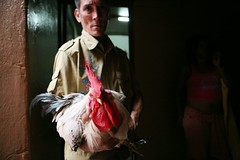
Industrialization of the food industry has further estranged modern societies from the bloody business of slaughter. Gone are the days when killing and plucking a rooster for Sunday dinner was an American family norm. Modern American's, especially those removed from rural life, are often repulsed and confused when slaughter occurs as part of religious practices. People from cultures where industrialized farming and Agribusiness are the way of life, often have difficulty conceiving of or witnessing any form of slaughter. In cultures where the slaughter and butcher of meats in the home remains prevalent, people have very little difficulty accepting ritual sacrifices as part of religion. "We feed ourselves and we feed the Gods." For these people ritual sacrifice is often part of everyday life. These are the kinds of cultures where Ifa, and Santeria are well established and visible.

Whether the entertainment industry has benefited these religions through increased exposure, or harmed them through negative depiction, is a matter of debate. What is certainly true. . . the worlds of arts and entertainment will continue to derive inspiration from them, religious scholars will investigate and share their findings, and dedicated initiates will continue to practice.

For information on the ritual practices of Santeria, refer to Sacrificial Ceremonies of Santería: A Complete Guide to the Rituals and Practices
, authored by Ócha'ni Lele , published by Destiny Books.

  Come back and read our review Friday, 9/5/2014.

Monday, August 25, 2014

Spirian Series Author Brings New Dimension to “Blind Seer” Heroine.

Ink Slinger's Whimsey would like to share with readers information about an eye condition called retinitis pigmentosa and introduce a fiction author, Rowena Portch, writer of The Spirian Series, who has overcome the condition in her own life; using it to enhance her work. Protected, book one of the Spirian series, will be our featured book review later this week.

Retinitis pigmentosa is a group of degenerative eye diseases affecting one in 4,000 people in the United States and roughly one out of 5,000 people Worldwide. The retina, which is located at the back of the eye, sends visual images to the brain. In patients with this disease, damage to the retina gets worse over time. Retinitis pigmentosa (RP) commonly runs in families and can be caused by a number of genetic defects. For those with RP, the photo receptors in the eyes progressively degenerate, causing side or peripheral vision, to slowly worsen over time. Night vision is also diminished, with central vision typically declining in the advanced stages of the disease. The condition may eventually lead to blindness, with most patients retaining at least partial vision, total vision loss being rare. Wearing sunglasses will help protect the retina from ultraviolet light and may help preserve vision, and vitamin A may slow the disease from getting worse but there is currently no known cure or effective treatment for RP. Signs of RP can usually be detected during a routine eye exam however; symptoms usually do not develop until adolescence, around 10 years old. Severe vision problems do not usually develop until early adulthood.

Author Rowena Portch retired from her successful career as an editor at Microsoft, when she lost her vision to RP. After leaving Microsoft, she and husband Gregg opened the Abel Wellness Center on Washington State’s Olympic Peninsula. Portch had already been writing professionally for over 30 years when she set out to write her ambitious 5 part Spirian Series. The Protected, book one of the series was released on May 11, 2010, rapidly growing a fan following and favorable reviews.

The Protected, are a supernaturally gifted race of beings, not quite human but not fully spirit, that secretly share this planet. Among themselves they are known as Spirians, a race caught between the physical and spiritual realms – where anything is possible. Skye, a blind massage therapist, has lived her whole life as human and is unaware of her race and the path her life is about to take. Skye may be the prophesied “Healer” whose gifts are pivotal in the course of her people’s future; a future that could bring about the enslavement of humanity. The Protected, book one of the series, takes the reader with Skye into the hidden world of the Spirians, where a few stand in the balance ready to teach Skye to use the power that is her birthright before she becomes a pawn in a much larger game.
“The depth of realism and texture Portch has written into the character and world of her “Blind Seer” heroine is untouchable by the writings of sighted authors. Once you read The Protected you’ll never believe another author trying to write blind again. Portch has written a unique and engaging series that will thrill and inspire
readers.” - Reviewer Vonnie Faroqui, of Ink Slinger's Whimsey
Learn more about Rowena Portch and the Spirian Series from her website at http://rowenaportch.com/ or by following her on http://twitter.com/RowenaPortch and at http://bit.ly/Facebook-RowenaPortch.


Wednesday, December 1, 2010

Article Marketing: An Example

November 17, 2010, I ran a small piece called Article Marketing: Promoting Your Book
This week I would like to offer an example of an article that has a search-able topic which ties in with an author's book promotion.

Retinitis Pigmentosa
Spirian Series Author Brings New Dimension to “Blind Seer” Heroine.


Ink Slinger’s Whimsey and Writers in the Sky [WITS] would like to share with readers information about an eye condition called retinitis pigmentosa and introduce a fiction author, Rowena Portch, writer of The Spirian Series, who has overcome the condition in her own life, using it to enhance her work.

Retinitis pigmentosa (RP) is a group of degenerative eye diseases affecting one in 4,000 people in the United States and roughly one out of 5,000 people Worldwide. The retina, which is located at the back of the eye, sends visual images to the brain. In patients with this disease, damage to the retina gets worse over time. RP commonly runs in families and can be caused by a number of genetic defects. For those with RP, the photoreceptors in the eyes progressively degenerate, causing side or peripheral vision, to slowly worsen over time. Night vision is also diminished, with central vision typically declining in the advanced stages of the disease. The condition may eventually lead to blindness, with most patients retaining at least partial vision, total vision loss being rare. Wearing sunglasses will help protect the retina from ultraviolet light and may help preserve vision, and vitamin A may slow the disease from getting worse but there is currently no known cure or effective treatment for RP.

Signs of RP can usually be detected during a routine eye exam however; symptoms usually do not develop until adolescence, around 10 years old. Severe vision problems do not usually develop until early adulthood.
Author Rowena Portch retired from her successful career as an editor at Microsoft, when she lost her vision to RP. After leaving Microsoft, she and husband Gregg opened the Abel Wellness Center on Washington State’s Olympic Peninsula. Portch had already been writing professionally for over 30 years when she set out to write her ambitious 5 part Spirian Series. The Protected, book one of the series was released on May 11, 2010. The Union, book two was released October 26, 2010. The series is already gaining popularity, favorable reviews, and has garnered the 2010 Readers Favorite Silver medal for General Fiction for The Protected.

The Protected, are a supernaturally gifted race of beings, not quite human but not fully spirit that secretly share this planet. Among themselves they are known as Spirians, a race caught between the physical and spiritual realms – where anything is possible. Skye, a blind massage therapist, has lived her whole life as human and is unaware of her race and the path her life is about to take. Skye may be the prophesied “Healer” whose gifts are pivotal in the course of her people’s future; a future that could bring about the enslavement of humanity. The Protected, book one of the series, takes the reader with Skye into the hidden world of the Spirians, where a few stand in the balance ready to teach Skye to use the power that is her birthright before she becomes a pawn in a much larger game.

Author Rowena Portch was featured on the Writers in the Sky Podcast aired over the Internet on August 6, 2010.
“The depth of realism and texture Portch has written into the character and world of her ‘Blind Seer’ heroine is untouchable by the writings of sighted authors. Once you read The Protected you’ll never believe another author trying to write blind again. Portch has written a unique and engaging series that will thrill and inspire readers.” says book reviewer and podcast host Vonnie Faroqui of Writers in the Sky Creative Writing Services [WITS]
Learn more about Rowena Portch and the Spirian Series from her website at http://rowenaportch.com/ or by following her on http://twitter.com/RowenaPortch and at http://bit.ly/Facebook-RowenaPortch. The author will meet and sign books for the public with events to be announced through BookTour.com.

Wednesday, November 17, 2010

Article Marketing: Promoting Your Book


By Vonnie Faroqui
Daily we at WITS are consulted by authors about book promotion and how to drive traffic to an author homepage. One powerful and non intrusive tactic for marketing your book and driving web traffic is through the intelligent use of article marketing. 

Bloggers and other online or print publications use sites like EzineArticles.com, ABC Article Directory and Etopic.com, to obtain free content that is available for republication.  These article database sites specialize in collecting the most up to date articles, on a variety of different topics and making those articles available for reprint.  Articles on these sites are available for use, free of charge and may be reprinted any number of times by multiple publications. 

WITS utilizes these sites to promote our authors and their books through article placement and marketing. We create content rich, key word optimized articles on topics that either introduce readers to a book and author or refer to an author’s work as a reference guide of unique knowledge and experience on a theme.
Articles we have written are reprinted across the internet and through conventional print media, giving our authors a broad range of exposure but the benefit of article marketing doesn’t stop there.  It is not necessary for an article to be republished in order to be found and read online by your audience. Simply being placed in one of these databases opens an  opportunity for your book and your name to enter the online stream of communication. These articles and database sites are also available to internet users surfing the web using key word search engines like Google.com. This makes article placement and marketing even more effective. 

To learn more about article marketing visit our author promotions page at Writers in the Sky.

Sunday, June 6, 2010

Artist Studio Declutter

Please join me in welcoming the virtual tour group following 27 Things to Feng Shui Your Home author Tisha Morris.


Yesterday, June 5, the tour was hosted by Yvonne Perry who published her book review for 27 Things on her writing blog at http://yvonneperry.blogspot.com/

Today I have the distinct pleasure of presenting Tisha Morris's expert advice on how to handle an artist studio declutter.  Take it away Tisha . . .

How Does an Artist Keep Her Studio Decluttered?

One of my readers posed this question: What does an artist do to keep her studio clear? After all, the lives of artists, writers, and other creative people collect all types of “special flotsam & jetsam in the name of the creative process.” According to this reader, there are so many items that need to be kept that are a record of process. How do we decide if our ephemera is worthy of that?


Great question and being a former Interior Design student and one who paints as a hobby, I can totally relate!

In my blog article, What Your Home Says About You, I note that artists tend to be more right-brained – the non-organizing part of the brain. And as I pointed out, is having your home, or especially your art studio, a little messy such a bad thing? Of course not. It’s all part of the creative process, right? Or is it?

We all have a different standard as to what is too messy or too much clutter. You know when your home or studio has gotten out of control. You feel scattered, cloudy, weighed down, or creatively stuck. That’s when you know it’s time to take action.

First off, the size of your studio space will ultimately dictate how much art and supplies you can have on hand. When it comes to art, you can fill a warehouse space just as easy as you could fill a small corner of the kitchen. For example, when I decided that I wanted to convert my art studio space from a whole room to a corner in order to do yoga, I had to downsize the amount of art materials I kept. So designating how much space you are willing and wanting to take up is the first step.

Next, organizing units are essential. If you don’t already have proper storage, then these can be purchased from any art supply store. Have proper storage and organization in your studio so that you will at least have a standard for organization and have a place for everything. That way, when you know your space has gotten too messy for even your right-brain, you have bins and drawers to put stuff in.

If you then have too much stuff to fit into your organizing units, then it’s time to downsize. This is where the emotional aspects come into play – what to keep and what not to keep. If you keep items for inspiration, such as photos, cards, images, etc., then go through them to see what still resonates with you. You may be surprised how different you may feel about some of the items. Discard any items that you don’t absolutely love or that no longer inspire you.

What about your own past work? This can be very difficult. It took me several different clearings to finally dispose of my interior design projects. I had kept what I needed for purposes of including in a portfolio. For boards that I knew I would never need or use again, I took pictures of them before eventually disposing of them. It was difficult knowing how much time had gone into them. But honestly, I haven’t missed them since. In fact, I feel much lighter once I got rid of them. Every time I would see them in the closet, I was subconsciously reminded of the long hours I spent on them. I still keep a small portfolio of photos I took of my projects for nostalgia.

When your designated space for past projects gets too full, then it’s time to go through them to determine what needs to go. For me, I periodically dispose of my pieces of art that aren’t that great, meaning that I’ve improved since then. For pieces of art or art supplies that you no longer want, consider listing them on freecycle.org or craigslist.com. Taking pictures of your work is a great way to track your progress without being overloaded with projects. Clearing out old projects will also make room for new ideas and creativity. So don’t get too weighed down in your past projects. Instead, let creativity flow through you and your studio.

Guest Blogger: Tisha Morris, author of 27 Things to Feng Shui Your Home.

Photo credit

Tomorrow June 7 sees the tour with The Shift Guru, Barbara Joye, featuring her Q and A interview with Tisha on http://shiftguru.wordpress.com/ . Follow Barbara Joye at @theshiftguru.


Don't forget to purchase your copy of 27 Things to Feng Shui Your Home, by author, Tisha Morris, available now at Amazon.com
ISBN: 978-1-59652-567-2
Publisher: Turner Publishing Company 2010
Price: $9.99

Also available with Barnes&Noble book sellers, Borders and Indie Bound.


Bookmark and Share


~~~~~~~~~~~~~~
For even more information about marketing your book online, read Book Marketing in the Digital Age, Online Promotion Made Easy.


Purchase Now!